Cultivating a Rhythm: How to Build a Seasonal Homeschool Plan
I have a confession. For the first few months of our homeschool journey, I spent more time planning than I did actually teaching.
I had spreadsheets—of course I had spreadsheets; I’m a corporate accountant, it’s basically my love language—but even with all that planning, we kept falling off track. Too rigid on Monday, completely abandoned by Wednesday.
What finally changed things wasn’t more planning. It was less. It was switching from a schedule to a rhythm.
There’s a real difference between the two, and once I understood it, everything got easier.
A schedule says: Monday — life cycle worksheet. Tuesday — anatomy diagram. Wednesday — nature journal.
A rhythm says: This season, we’re watching things grow. We go outside first. We wonder out loud. We write it down when we’re ready.
One feels like a clock. The other feels like the farm itself — predictable in a gentle way, flexible when it needs to be, and always rooted in what’s actually happening outside.
If your homeschool plan is working great for two weeks and then completely falls apart, I’d bet money you’re running on a schedule when your family actually needs a rhythm.
Start with one anchor, not ten.
I used to try to cover everything in a month. Science, history, art, literacy — all loosely tied together around whatever we were studying. It was exhausting and shallow.
Now I pick one seasonal anchor topic — one thing that’s actually alive and visible and accessible right where we live — and I let everything branch off of it. In early spring, that’s been our garden: germination, earthworms, honeybees. In summer, we’ll shift to what’s moving and buzzing in the heat.
When you go deep on one thing instead of skimming ten, kids actually remember. More importantly, they get excited to tell you what they notice. My daughter stopped me on the way to the barn last week to point out exactly where a spider had rebuilt her web after a rainstorm. That doesn’t happen with a worksheet.
Build a repeatable weekly flow.
You don’t need a different activity every single day. You need a structure your child can anticipate. Ours looks roughly like this:
We always start with observation — outside if we can, at the window if we can’t. Then we talk about what we saw and I introduce one or two new vocabulary words, not as a quiz but just worked into conversation. Midweek is when we do our hands-on activity, whether that’s a science experiment, an art project, or a craft. Toward the end of the week we do a journal page or diagram. And we finish by letting her tell me one thing she noticed that she wants to remember.
That’s it. Same shape every week. The topic changes with the seasons, but the flow stays familiar enough that she doesn’t dread it and I don’t have to reinvent the wheel.
Plan light and leave room for real life.
I work full time. We have a farm. Some weeks, the chickens get out and someone has a fever and the whole thing gets compressed into two days. That’s just life.
The families I see thrive with nature study are the ones who build margin into their week from the start. If you plan five packed days and one thing goes sideways, the whole thing feels like failure. If you plan four solid sessions and expect one to be a ten-minute walk, you end up feeling ahead most weeks instead of behind.
End with reflection, not a grade.
At the end of every study — sometimes at the end of a week, sometimes at the end of two — I ask my daughter three questions: What did you notice? What changed? What do you want to learn about next?
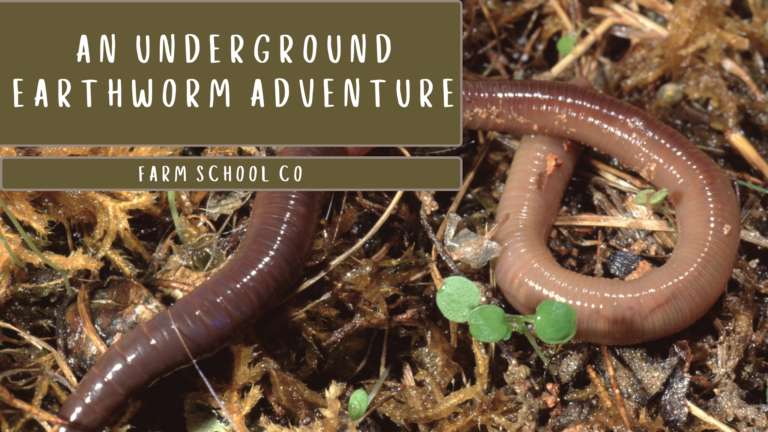
Her answers have shaped our entire curriculum more than any scope and sequence I could have bought. She’s the one who asked why earthworms don’t have eyes after our earthworm week. That question turned into two more days of digging and reading that I never could have planned.
A seasonal rhythm gives you enough structure to actually show up, and enough flexibility to follow the child in front of you. That’s the whole goal.
If you’re looking for a place to start, our nature studies are built to work exactly this way — open-and-go, with built-in observation, science, art, and reflection that fits into a two-week rhythm without taking over your whole life.