5 Ways to Teach “Complex” Science to a 5-Year-Old (Without Them Realizing It)
I hear this confession from moms all the time.
“I am great at reading stories. I can handle art projects. But science? I am just not a science person.”
When we think of science, we usually think of high school chemistry labs. We think of bubbling beakers, periodic tables, and safety goggles. It feels dangerous. It feels complicated.
But here is the secret. Preschool science is just fancy noticing.
You do not need a lab coat to teach your child about physics or biology. You just need to look at the world a little closer. In fact, you are probably already doing “Sneaky Science” without realizing it.
Here are five ways we turn simple farm observations into “complex” science lessons.

1. The “Clock” Lesson (Astronomy)
The Simple Moment: You are playing in the driveway, and you notice your shadow has moved. The Complex Science: Planetary Rotation.
It looks like the sun is moving across the sky, right? That is what our eyes tell us. But “Sneaky Science” teaches us the truth: The sun stays still. We are the ones moving.
Try This: Go outside in the morning and trace your child’s shadow with sidewalk chalk. Go back at lunch and stand in the same spot. Trace the new shadow. Ask them: “Did the sun move, or did the Earth spin us around?” Boom. You just taught an astronomy lesson before lunch. No telescope required.

2. The “Insulation” Lesson (Hay vs. Straw)
The Simple Moment: You see a bale of hay and a bale of straw. The Complex Science: Thermodynamics and Insulation.
Most adults use these words interchangeably, but they are totally different!
-
Hay is food (energy).
-
Straw is bedding (warmth).
When you teach your child that straw is hollow like a drinking straw, and that the trapped air keeps the heat inside, you are teaching them Thermodynamics. You didn’t need a textbook. You just needed a piece of straw.
-
Try It: Our Hay & Straw Science Lab includes the “Warm Barn” experiment, where kids wrap an ice cube in paper “straw” to see if it melts slower than a naked ice cube. It proves the science instantly!

3. The “Puffer Jacket” Lesson (Feathers)
The Simple Moment: You see a bird sitting on a fence in the snow. The Complex Science: Adaptation and Biomimicry.
Ask your child: Why doesn’t the bird put on a coat? Then explain that they are wearing one! Birds have tiny muscles that lift their feathers up to trap warm air against their skin. It works exactly like the puffy winter coat your child is wearing.
We call this Adaptation. It helps children understand that animals are designed with a purpose.

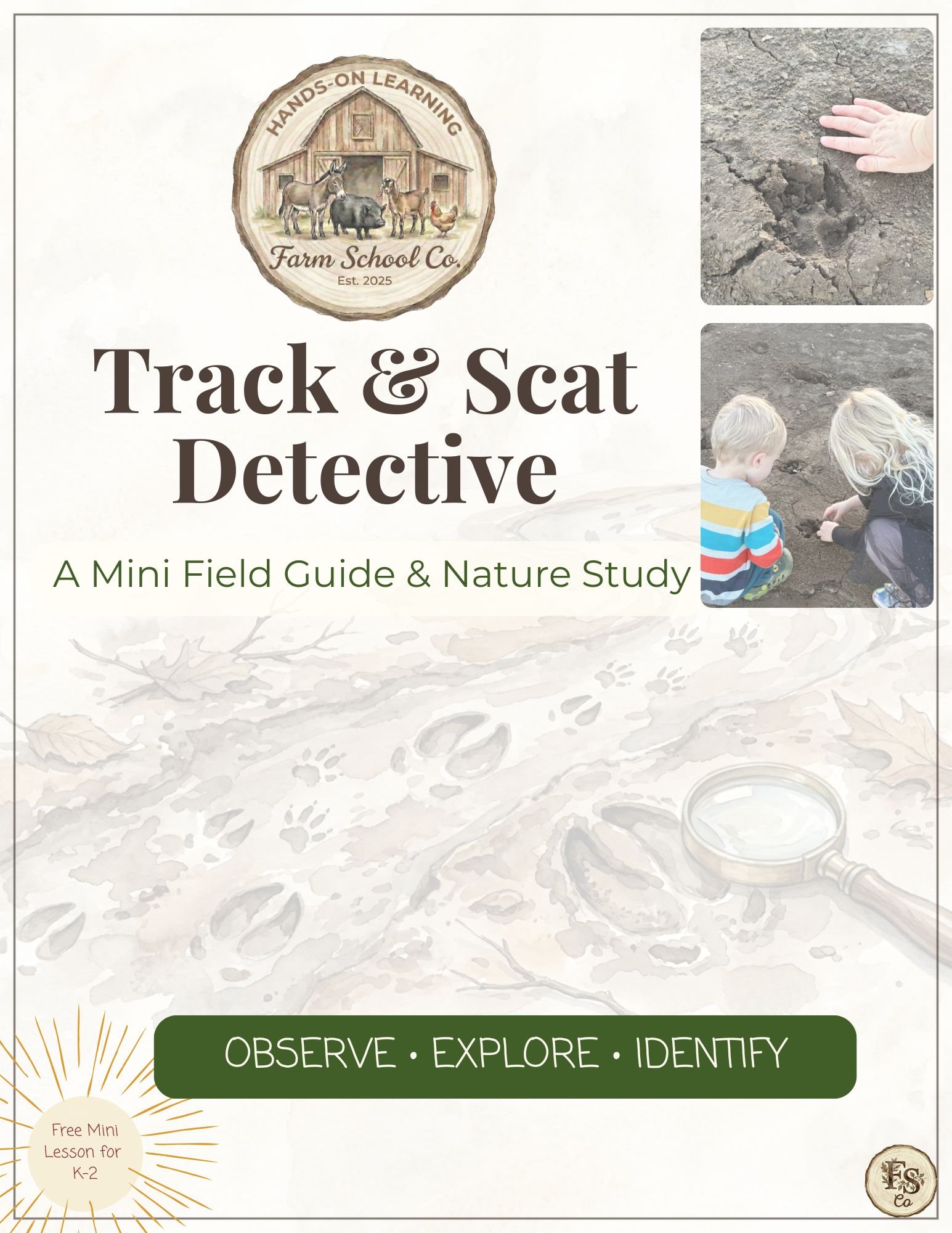
4. The “Detective” Lesson (Footprints)
The Simple Moment: You see tracks in the mud. The Complex Science: Ethology (The study of animal behavior).
In our Free Animal Track Explorer Pack, we give your child the tools to observe like an ethologist. When your child looks at a footprint and says, “The duck walked here because I see webbed feet,” they are gathering data. They are analyzing evidence.

5. The “Yucky” Lesson (Decomposition)
The Simple Moment: Your child finds a mushy, rotting log or a dead leaf on the ground. The Complex Science: Biological Decomposition and Nutrient Cycling.
It is natural to want to say, “Ew, don’t touch that, it’s dirty!” But in science, “yucky” usually means something important is happening. When a log rots, nature is running a recycling plant. Fungus and bugs are breaking down the old wood to turn it back into soil so new trees can grow.
Try This: Next time you find a rotting log, flip it over. Count the bugs underneath. Explain to your child: “These bugs are the trash collectors. They are turning this old log into fresh dirt.”
Tip: If you want to get a closer look without touching the slime, we use These Jumbo Magnifying Glasses. They are durable enough for toddlers but strong enough to see the tiny details of a pill bug!

6. Bonus: Let Us Be Your Cheat Sheet You do not need to know all the answers. That is my job!
I created Farm School Monthly to be the guide to bring fun back to learning so your kids don’t know it’s happening. I plan the experiments, I write the scripts, I film the videos, and I explain the “why” behind the “wow.” You just get to enjoy the magic with your kids.
If you are ready to try some Sneaky Science this week, grab our Hay & Straw Science Lab. It is the perfect way to dip your toe into real-life learning without the overwhelm.
This post contains affiliate links. As an Amazon Associate, I earn from qualifying purchases. This means if you click and buy, I may receive a small commission (at no cost to you). This helps support our growth. Thank you for supporting our small business!